

Onboarding. Operations.
Organized.
Built for Independent Insurance Agents
New Hire Onboarding | Insurance Carrier Directory | Vendor Directory | Document Library
Ask most independent agency owners how many carriers they’re appointed with, and you’ll get a pause. Ask for the agency code for a carrier they write twice a year, and someone starts digging through email. Knowing how to track carrier appointments isn’t glamorous, but it touches quoting, commissions, compliance and onboarding.
Here’s how to get your carrier information organized and keep it that way.
“Using a notebook or word document to manage carriers has been an industry standard for decades. I’ve seen them be misplaced, spilled on, deleted, thrown in the shredding bin by accident. Producers are just as responsible for keeping track of this as the agency principal. But a system that makes it simple and organized, heads off problems that are almost guaranteed to happen. “
Adam Morris, founder of Wayset
Why carrier tracking gets messy
Independent agencies work with many carriers, often through a mix of direct appointments and access through a network or aggregator. Each relationship comes with its own pile of details:
- Agency codes and producer sub-codes
- Portal URLs and individual user logins
- Underwriter, marketing rep and claims contacts
- Appetite notes on which lines and risks the carrier wants
- Commission schedules and contingency agreements
- Appointment dates and which producers are appointed
That information usually lives in five places: a spreadsheet someone started years ago, the agency management system, a shared drive, a binder and the owner’s memory. Every one of those is out of date in a different way.
What to track for each carrier
Start by building one record per carrier with the same fields every time. Consistency is what makes the list usable.
| Field | Why it matters |
| Carrier name and lines written | Staff can see at a glance who to quote for a given risk |
| Agency code and producer sub-codes | Needed for quoting, submissions and commission questions |
| Appointment status and date | Confirms you can actually place business there |
| Access type (direct or through a network) | Determines who to call and how commissions flow |
| Portal link and who has a login | Speeds up service and makes offboarding safe |
| Underwriter and marketing rep contacts | Saves time on submissions and escalations |
| Appetite notes | Prevents wasted quotes on risks the carrier won’t write |
| Key documents | Agency agreement, commission schedule, guidelines |
Track appointments at the producer level too
Carrier appointments aren’t just an agency-level fact. In most states, individual producers must be appointed with a carrier before they can sell its policies. That means you need to know which producers are appointed with which carriers, and when.
Keep a simple producer-by-carrier view. When you hire someone, it tells you which appointments to request. When someone leaves, it tells you exactly which appointments to terminate and which logins to shut off.
Keep it current with a few habits
A carrier list decays the moment you stop maintaining it. These habits keep it accurate:
- Update the record the same day a code, contact or appointment changes
- Review the whole list once a quarter, and remove carriers you no longer write with
- Assign one owner for carrier information so updates don’t depend on whoever remembers
- Store logins in a password manager, and record in the directory who has access to each portal
Why spreadsheets stop working
Spreadsheets are a fine start. But they don’t hold documents well, they get copied and fall out of sync, and they make it easy to share more access than you intended. Once you pass a handful of carriers and a few employees, a dedicated carrier directory saves real time.
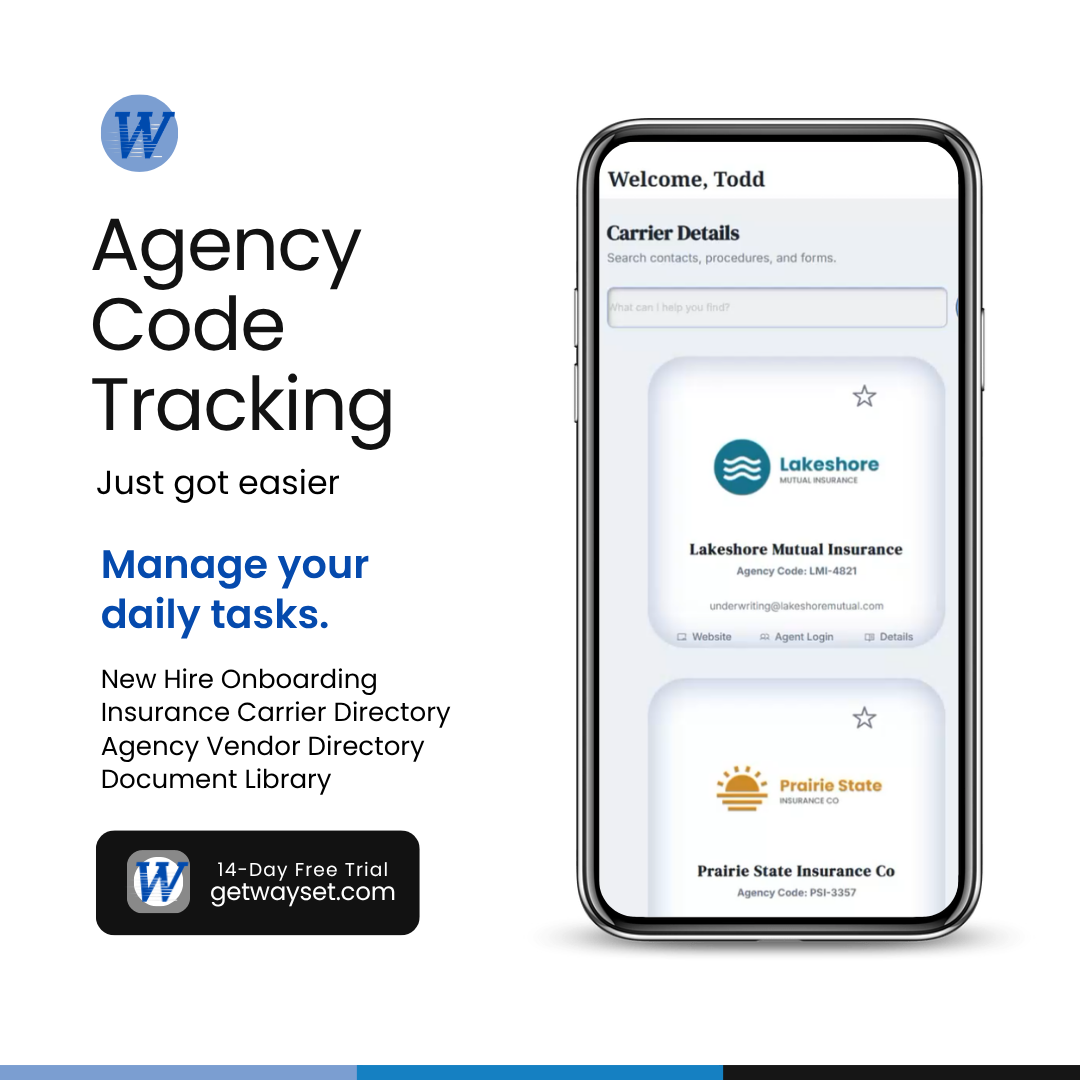
Wayset was built for this. It gives your agency one carrier and vendor directory with codes, contacts, appetite notes, documents and portal links, organized for independent insurance agencies. New hires find what they need on day one, and you always know who has access to what.
FAQ
What is an agency code in insurance? An agency code is the identifier a carrier assigns to your agency. It ties quotes, policies and commissions to you. Many carriers also assign sub-codes to individual producers or locations.
Do producers need to be appointed with each carrier? In most states, yes. Each producer generally needs an appointment with a carrier before selling its products. Requirements vary, so check your state insurance department.
How do independent agents keep track of carriers? The most reliable way is one central carrier directory with consistent fields for codes, contacts, appointments, appetite and documents, reviewed every quarter.